Open source · Apache 2.0Local-first · CPU-onlyNo API keyNo billingRust + Python
ThotBook-AI
The first fully scientist-made LLM toolset: an open-source, local, CPU-only pipeline
that turns your own corpus — sessions, notebooks, paper indexes — into a
private, OpenAI-compatible assistant. Reliable and FREE:
free by principle, free by design, free as a common good.
Ingest your knowledge corpus, tokenize it, then fine-tune and serve a private model —
mirroring commercial "Copilot" products without the subscription, the data leaving
your machine, or the vendor lock-in.
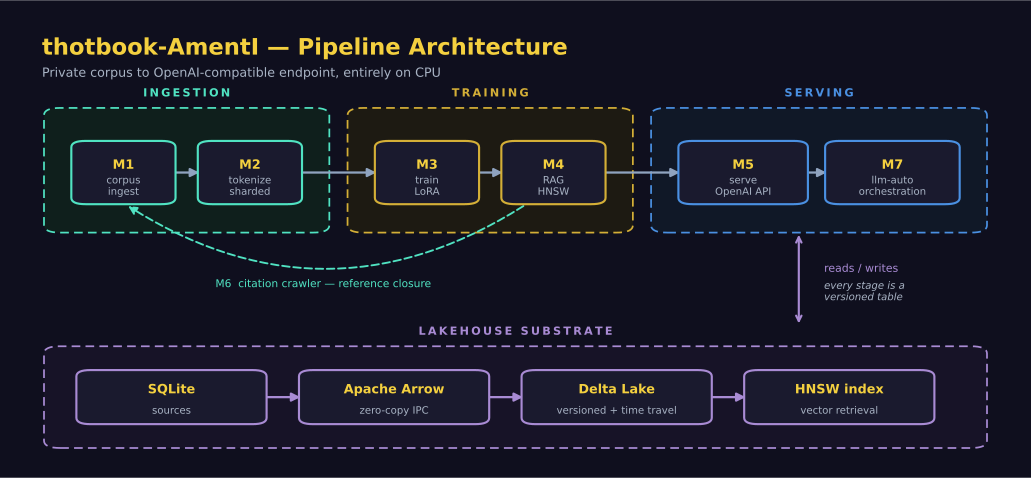
Every stage writes versioned Apache Arrow → Delta lakehouse tables while redacting
secrets at ingest time, and the whole pipeline runs on a laptop (32 GB RAM, no GPU).
The companion scientific-computing engine optimiz-rs provides the underlying numerical primitives.
Local by design
Qwen3-8B served via Rust candle on CPU. No GPU, no cloud, no
API key, no billing. The model never leaves your machine.
Private by principle
Every document is redacted at ingest time and a write-time leak audit refuses
any row that still contains a secret. Your research stays yours.
Open by common good
Apache 2.0 weights, MIT / Apache 2.0 code, one scientist building research
infrastructure for scientists — free on purpose, not as a trial.
OpenAI-compatible
Drop-in /v1/chat/completions. Ask from the CLI, from Python, or from opencode itself:
python -m thotbook_ai chat \
  "Give one line of Kähler geometry intuition."
Free for a reason.
Science advances when tools are shared. HFThot Research Lab publishes its working
papers openly and builds the
lab's toolset in the open so that every researcher — in any means-tested classroom,
university, or start-up — has a free, trustworthy assistant rather than a vendor lease.
Built with and for the community
Contributions, bug reports and maths pedagogy feedback are welcome. The corpus
pipeline, tokenizer and inference probes are public; the ncatlab-style inference
benchmark ships with the repository.